







|
|
|
|
|
|
||
| Released by Allama Syed Qamar Haider Zaidi; | ||
| Mourning rituals are the sacred trust of Imam Zain al-Abidin and Zainab bint Ali, and they are the guarantee for the continuity of Husayniyyat - Hussain Muqadasi | ||
|
RAWALPINDI, July 12:
Mourning rituals are the sacred trust of Imam Zain al-Abidin and
Zainab bint Ali, and they are the guarantee for the continuity
of Husayniyyat. The coating of materialism and the pursuit of
worldly prestige upon mourning rituals is intolerable for the
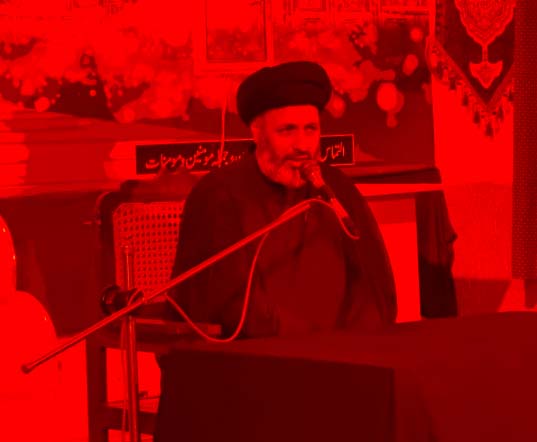
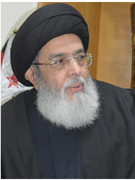
mourners, said Allama Agha Hussain Muqaddasi. Chief of Tehreek Nafaz Fiqh Jafaria Pakistan, Allama Agha Syed Hussain Muqaddasi, stated that the mourning rituals are the sacred trust of Imam Zain al-Abidin and Zainab bint Ali and are the guarantee for the continuity of Husayniyyat. The coating of materialism and the pursuit of worldly prestige upon mourning rituals is intolerable for mourners. He said that the United States had condemnably violated ceasefire agreements, insulting international law and resorting to bullying. He added that American aggression had affected the entire world and that the situations in Badakhshan and Balochistan were the handiwork of the three satans—the United States, Israel, and India—as well as silent profiteers. He stressed that it was imperative to decisively suppress the ongoing unrest against Pakistan, urging the government to convene an All Parties Conference and launch a full-scale operation on the Malakand model. He further said that the Central Asian dream of access to warm waters would not materialize and called for Indian interference in Balochistan to be raised before the United Nations Security Council. He expressed these views while addressing the Ashra-e-Bimar-e-Karbala gathering held at Jamia Masjid and Imambargah Ahl al-Bayt, Wah Cantonment, on the occasion of the martyrdom of Imam Zain al-Abidin. The Ashra-e-Bimar-e-Karbala was observed from 15 to 25 Muharram throughout the country, as well as around the world, with devotion and respect. He urged the government to fulfill its commitments to facilitate mourners and stated that effective implementation of the National Action Plan was the best remedy for internal instability. The Chief of Tehreek Nafaz Fiqh Jafaria said that those who seek to overshadow the meaning and spirituality of mourning rituals with materialism and worldly prestige are unfamiliar with the philosophy of Azadari. He described the mourning of Imam Husayn as an unalterable divine decree and an everlasting system of guidance leading to the Banner of Divine Praise. He further stated that attempting to undermine the sanctity of the mourning rituals is tantamount to waging war against Husayniyyat. Allama Agha Syed Hussain Muqaddasi said that in Surah Ibrahim, Allah emphasized the revival, honor, and sanctity of the Days of Allah. According to the commentaries Basa'ir al-Darajat, Al-Burhan, and Nur al-Thaqalayn, and the sayings of Imam Ja'far al-Sadiq and Imam Muhammad al-Baqir, the inner meaning of the Days of Allah refers to the Ahl al-Bayt. He added that Shaykh al-Saduq narrated in Ma'ani al-Akhbar and Al-Khisal, through Imam Ja'far al-Sadiq, the well-known saying of the Holy Prophet: The Days of Allah are us: the Day of the Qa'im, the Day of Raj'ah, and the Day of Resurrection. He explained that this means the Days of Allah are represented by the Ahl al-Bayt, namely the day of the appearance of al-Qa'im from the family of Muhammad, the Day of Return, and the Day of Resurrection. He further cited another narration from Imam Muhammad al-Baqir, who interpreted the Qur'anic verse And remind them of the Days of Allah as referring, in its inner meaning, to the days of the Family of Muhammad. The Chief of Tehreek Nafaz Fiqh Jafaria, Allama Agha Syed Hussain Muqaddasi, reaffirmed his determination to continue striving for the protection of mourning rituals by following the teachings and guiding principles of the spiritual leader and Leader of the Jafaria community, Agha Syed Hamid Ali Shah Moosavi. |
||
|
|
||
|
|
||